


Rubén Alonso | Head of Secure
Development Unit, Telefonica
Security teams can no longer rely on exposure discovery alone.
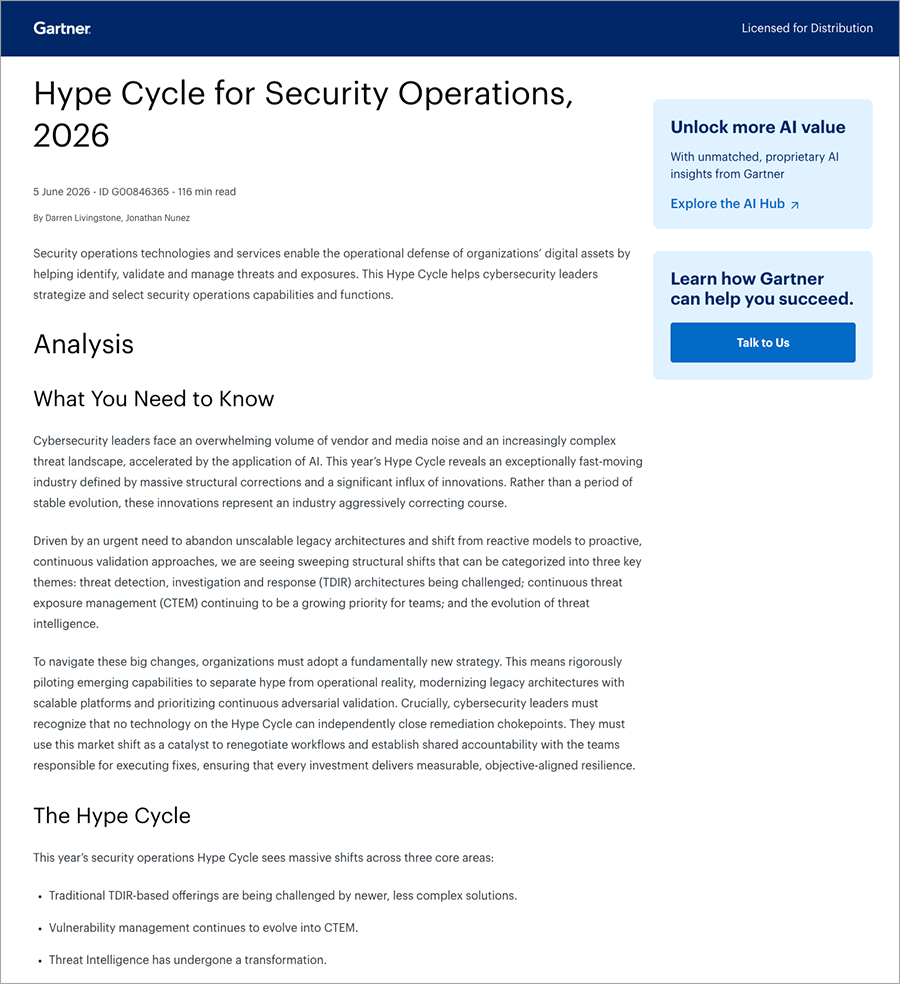
As organizations move from reactive security operations toward Continuous Threat Exposure Management, Gartner’s 2026 Hype Cycle for Security Operations reinforces the growing role of proactive, continuous validation.
Adversarial Exposure Validation is positioned as a key technology in this shift, helping organizations validate which exposures are truly exploitable in their environments, assess real attack impact, and measure whether security controls can withstand realistic attack scenarios.
Pentera is recognized as a sample Vendor in the Adversarial Exposure Validation category.
Exposure Assessment Platforms help organizations identify, aggregate, contextualize, and prioritize exposures across the environment. But identifying risk is only part of the challenge.
AEV provides active validation, proving whether attack paths and exposures can actually be exploited.
For security teams overwhelmed by growing exposure data, this distinction matters.
Organizations need proof of which exposures create real attack risk and which remediation actions will have the greatest impact.
Discovery, prioritization, and attack-path visualization are becoming foundational capabilities in exposure management. The next step is active validation: proving which exposures are exploitable and whether security controls are working as expected.
Security teams are under pressure to reduce risk without overwhelming remediation owners with more findings. AEV helps prioritize based on validated evidence, enabling teams to focus on exposures that represent real attack risk rather than theoretical severity alone.
Human-led red team programs are valuable but difficult to scale continuously across complex environments. AEV helps automate repeatable validation activities and enables organizations to test attack scenarios more consistently across their environment.
As continuous validation becomes a core part of exposure management, organizations need evidence they can use to support internal reporting, audit conversations, compliance programs, and cyber insurance requirements.
Gartner does not endorse any company, vendor, product or service depicted in its publications, and does not advise technology users to select only those vendors with the highest ratings or other designation. Gartner publications consist of the opinions of Gartner’s business and technology insights organization and should not be construed as statements of fact. Gartner disclaims all warranties, expressed or implied, with respect to this publication, including any warranties of merchantability or fitness for a particular purpose.
This graphic was published by Gartner, Inc. as part of a larger research document and should be evaluated in the context of the entire document. The Gartner document is available upon request from Pentera.[LA1]
What’s Inside?