


Pentera Logo Pentera Logo White
resources
Jul 2026
AI Double Agent: Claude Just Got a New Voice
How we went from a compromised Claude account to remote code execution on a victim’s...
Read now
“Pentera helps us prioritize what truly matters and gives us confidence we are covering our global environment continuously.”

“Seeing a domain admin account cracked in production changed how we view internal exposure.”

“Pentera helped us advance our red team and continuously improve penetration testing.”

“Pentera makes it easier to focus on what is truly exploitable instead of chasing long vulnerability lists.”

“In a complex, large-scale environment, Pentera delivers the speed and visibility security teams need.”

“Pentera amplified our team’s performance and delivered measurable value to upper management.”

"Pentera allows us to tailor testing to each service, reduce time and costs, and shift our focus from simply finding vulnerabilities to actively helping our teams fix them.”


Rubén Alonso | Head of Secure
Development Unit, Telefonica

“I don’t think we’d be able to advance our red team without Pentera. If you’re looking to improve penetration testing, I would definitely recommend it.”

Owen Fuller | Cybersecurity Engineering
Manager, Casey’s

Pentera Solutions

Automated Pentesting

Enterprise-scale security validation on demand
Annual penetration testing can't validate security at the pace of change. Assume the attacker's perspective with AI-driven pentesting across your internal networks, external assets, cloud environments, and identities. Continuously uncover exploitable security gaps, validate their impact, remediate quickly and prove exposure reduction.
Don't wait a year to discover what an attacker can exploit today.
Thanks for reaching out! We'll be in touch soon to set up your personalized demo - prepare to unlock security insights about your environment!
TRUSTED CUSTOMERS
Why Automated Pentesting?

The benefits of automated pentesting with Pentera

Automated pentesting helps teams test continuously, validate real exploitable exposure, and measure risk reduction over time, supporting your Continuous Threat Exposure Management (CTEM) program.
On-Demand Testing
On-Demand Testing
On-Demand Testing

Launch automated pentests whenever your environment changes, without waiting for consultants, scheduling engagements, or adding headcount.

Enterprise Scale
Enterprise Scale
Enterprise Scale

Expand pentesting to cover your complete enterprise attack surface, validating more systems, environments, and business units in a fraction of the time.

AI-Driven Operations

Start tests, ask questions, and extract insights directly from the platform or through your LLM of choice using Pentera’s MCP server.

Safety by Design
Safety by Design
Safety by Design

AI-driven testing is governed by a deterministic attack engine that keeps every action safe, controlled, and auditable, allowing organizations to validate real-world attacks without risking business disruption.

Actionable Findings
Actionable Findings
Actionable Findings

Get clear answers from your data without digging through reports. Utilize Pentera Peer or our MCP Server connection to ask questions, summarize attack paths, identify what to fix first, and generate contextualized answers from the data.

Role-Based Insights
Role-Based Insights
Role-Based Insights

Deliver the right level of detail to every stakeholder, from executive summaries and AI Insights Reports to technical findings and remediation guidance.

Automated Remediation

Mobilize remediation through automated workflows in Pentera Resolve. Consolidate findings, assign ownership, route tickets, track SLAs, and automatically retest fixes to close the loop on exposure reduction.

HOW IT WORKS

Launch automated pentests in minutes

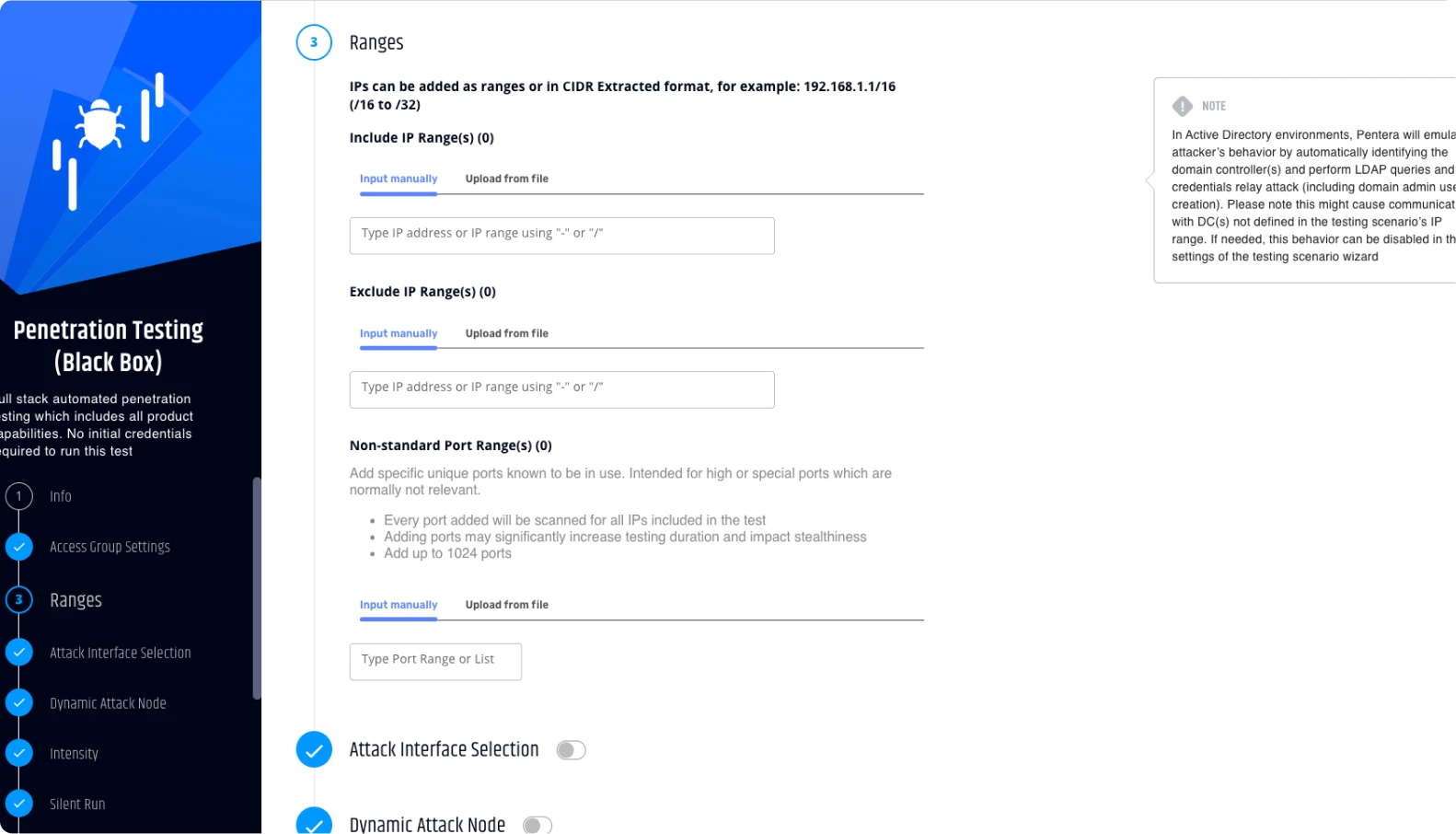
Kick off automated penetration testing with a few clicks, a scheduled scenario, or a natural-language prompt through your preferred LLM via Pentera's MCP server. Define the objective, set the scope, and let the attack engine safely emulate adversary behavior across the environment.
  • Configure
  • Set the Scope
  • Run the Exercise
  • Act on the Results
  • Generate a Report
Configure
Configure the Objective

Choose the type of test you want to run, including options such as a Black Box tests, assumed breach scenarios, or OWASP Top 10 testing.

Set the Scope
Set the Scope

Define the environments, assets, credentials, and guardrails for testing.

Run the Exercise
Run the Exercise

Launch the test on demand, on a schedule, or through an AI prompt, then let the engine execute the adversarial workflow safely and continuously.

Act on the Results
Act on the Results

Use validated findings to understand what attackers could achieve, prioritize proven risk, and mobilize remediation in Pentera Resolve through ownership assignment, ticket routing, SLA tracking, and retest to validate remediation.

Generate a Report
Generate a Report

Turn validation data into executive-ready summaries, technical reports, and contextual answers using AI Insights Reports, Pentera Peer, or your LLM of choice through the MCP server.

Areas of Activity

Where Pentera operates

Internal Networks & Infrastructure

External Attack Surface

Cloud Infrastructure

Hybrid Environments

Containers (Kubernetes)

Active
Directory

Identities
& Access

APIs

Web
Applications

AUTOMATED PENTESTING USE CASES

Choose the test that fits your security objective

Run the right automated pentest for your business needs, whether you're validating external exposure, assessing insider threat risk, testing cloud
security, strengthening Active Directory, or measuring ransomware readiness.

Black Box Testing

Validate security from an external attacker's
perspective by identifying exploitable attack
paths without relying on prior access,
credentials, or environmental knowledge.

Assumed Breach &
Insider Threat Testing

Determine what attackers could
achieve after gaining initial access
through compromised credentials,
phishing, or third-party compromise.

External Attack
Surface Validation

Continuously assess internet-facing assets,
exposed services, web applications, APIs, and
leaked credentials to identify exploitable entry
points before attackers do.

Cloud Attack Validation

Evaluate cloud identities, permissions,
secrets, workloads, and hybrid attack paths to
uncover security gaps that could lead to
cloud compromise.

Active Directory
Password Assessment

Identify weak and easily compromised
passwords that increase the risk of
account takeover, privilege escalation, and
domain compromise.

Ransomware
Readiness Testing

Assess organizational resilience against
reconstructed ransomware campaigns based on
leading groups such as LockBit, BlackCat (ALPHV),
Conti, REvil, Maze, Cl0p, Play, and Qilin, validating
whether attackers could achieve encryption, data
theft, and operational disruption.
UNDERSTAND YOUR EXPOSURE

What Pentera validates

Leverage AI-driven automated pentesting to proactively validate everything attackers can exploit.

Initial Access Points

Identify the exposures attackers can use to gain a foothold, including internet-facing assets, exposed services, vulnerable applications, leaked credentials, and phishing-susceptible accounts.

Security Control Gaps

Validate whether security controls prevent, detect, and respond to real-world attack techniques, including EDR, XDR, identity, and network controls.

Exposed Credentials

Identify credentials that have already been exposed, leaked, compromised, harvested, or reused, and validate whether attackers can use them to gain access or to advance an attack.

AD Password Risks

Identify weak, reused, and easily cracked passwords across Active Directory, revealing accounts that attackers can compromise despite meeting password policy requirements.

Misconfigurations

Uncover insecure configurations across infrastructure, cloud resources, identities, and applications that increase attack exposure.

Network Segmentation Gaps

Determine whether attackers can move laterally between systems, networks, and business-critical environments, exposing weaknesses in segmentation controls and Zero Trust architectures.

Excessive Privileges

Reveal users, service accounts, and cloud identities with access beyond what is required, increasing the impact of compromise.

Sensitive Data Exposure

Validate whether attackers can gain unauthorized access to sensitive data, exfiltrate business-critical information, or leverage it to advance an attack.

Remediation Gaps

Verify whether security fixes have eliminated exposure or whether exploitable attack paths remain.
AUTOMATED PENTESTING vs. Traditional Pentesting

A different approach to exposure validation

Capability
Frequency
Coverage
Scalability
Validation
Remediation
On-demand
Enterprise-wide validation
Expands with the environment
Continuous validation
Natively integrated remediation workflows
Traditional Pentesting
Annual or periodic
Limited scope and sample-based testing
Limited by consultant availability and budget
Point-in-time snapshot
Static reports and manual follow-up

Frequently asked questions

No. Pentera is designed for continuous pentesting. Organizations can run automated pentests on demand, after infrastructure changes, following remediation efforts, or on recurring schedules across internal networks, external attack surfaces, cloud environments, and identities. Unlike traditional penetration testing, testing frequency is not constrained by consultant availability or engagement cycles.

Traditional vulnerability scanners identify potential weaknesses based on CVEs and configuration checks. Pentera safely tests whether those weaknesses can actually be exploited, chains vulnerabilities, misconfigurations, and credential exposures into real attack paths, and shows the impact attackers could achieve.

Yes. Pentera’s AI-driven testing is governed by a deterministic attack engine that keeps every action controlled, repeatable, and auditable. This enables organizations to validate real-world attacks in production without risking business disruption, data loss, or uncontrolled execution.

Validate your real exposure

See how attack-path validation transforms
your security posture in minutes