
























On June 22, five intelligence agencies warned that AI would reshape offensive cyber in months, not years, a warning OpenAI effectively date-stamped just a few hours later. The advice in it isn’t new. What’s new is how little time the agencies think you have.
The heads of the Five Eyes cyber agencies put their names on a rare joint statement. The line everyone pulled from it: “The timeline is not years, it is months.”
The same day, OpenAI expanded Daybreak, its defensive cyber tooling, and released a more capable version of its cyber model. Their framing for the moment: “AI has changed the physics of cybersecurity.”
On its own, the agency statement is easy to file under things we already knew. Patch faster, shrink the attack surface, retire legacy systems, fix identity, assume breach: none of it is new, and plenty of people said so within hours. But that reaction misreads the reality, because the warning is not about the advice, it’s about the timing.
Why five agencies bothered
Five national agencies don’t co-sign a document just to repeat common knowledge. Two core claims drive this. First, the time between a vulnerability being found and exploited is shrinking to almost nothing. Second, just having security controls isn’t enough anymore. Leaders have to know their defenses will actually hold during a live attack, not just that they look good on a diagram.
Notice who it is written for. The language is continuity, market confidence, and long-term value. This is a business-risk memo in the format of a cyber advisory, aimed at the board rather than the SOC.
Discovery got cheap
OpenAI’s announcement is the clearest articulation of what changed under the checklist. For years, the expensive and rare skill was finding vulnerabilities. Models now do that at scale, and a vulnerability report on its own protects no one. So the bottleneck moves downstream, to validating which findings are real, deciding which ones matter, and validating the fix. Their updated model reportedly hits 85.6% on a benchmark for reproducing known vulnerabilities, up from 81.8%. You can argue about what benchmarks actually measure but the direction of the number isn’t in dispute.
Two things are converging. OpenAI’s code tooling does not just flag a vulnerability, it checks whether the vulnerable code is reachable before it bothers you. Adversarial exposure validation does the same thing one layer up: it checks whether an exposure is reachable and exploitable across a live environment, not merely present in a scan. Same logic, applied at two different layers. When findings become cheap and infinite, a finding stops being a signal. Proof that it is reachable and exploitable becomes the signal.
What this means in practice
- Replace point-in-time assurance with continuous validation. “Months, not years” is a cadence requirement. If your risk picture goes stale in a quarter, an annual test is theater.
- Prioritize by exploitability, not by volume. You are about to be buried in AI-found findings. The ones that matter are the ones that chain into a real path.
- Validate response, not just prevention. The statement assumes you will be breached. Track the path an attacker takes after the first door opens, and measure how fast you contain it.
In the real world
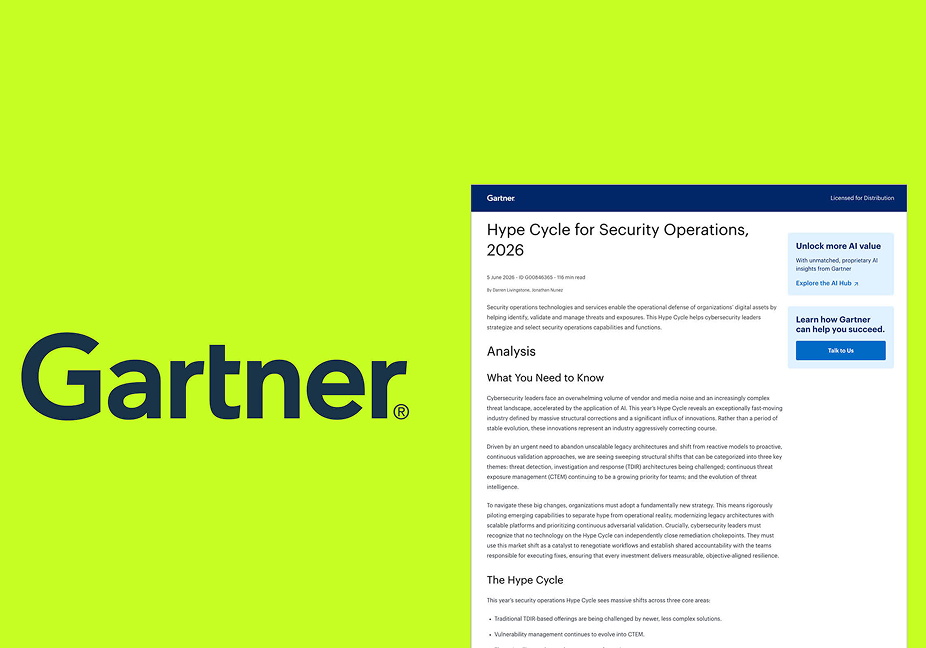
Gartner defines adversarial exposure validation as continuous, automated evidence that an attack is feasible and that your controls can be bypassed. Set that next to the statement’s demand to prove your controls hold under pressure, and the two say the same thing.
Things got blurred together in the coverage, and they’re worth pulling apart. AI that finds and patches vulnerabilities in code, which is what OpenAI shipped, secures the software you build. It does not tell you whether that patched system, dropped into your real environment with your identities, your cloud, and your segmentation, is safe. A clean repository is not a validated enterprise.
When you’re validating the live environment rather than the code, the AI is one piece of the system, not the whole thing. Deterministic attack logic keeps testing safe and repeatable in production, which is the only condition under which a result is worth anything in an audit. An agentic layer adapts the test as identities and configurations shift underneath it. That is what “use AI deliberately” looks like when the output has to be trusted rather than admired. And validation that does not end in a fix is just a longer report, so the loop has to close: validate, remediate, validate again.
The basics were never the problem
Success will not come from owning the most tools. It comes from getting the basics right, quickly, and proving they hold.
What’s hard is proving they work at the speed an AI-equipped attacker now moves. The agencies are pointing at that from the defensive side. The labs are pointing at it from the offensive side.
The timeline is months, not years. The almost reassuring part is that you already know what to do. The only question the statement is asking is whether you can prove you have done it.