


























Picture the attacker who just found a flaw in your customer portal, an authorization gap, for example: one tenant can quietly read another’s data. Do they write it up and file a ticket?
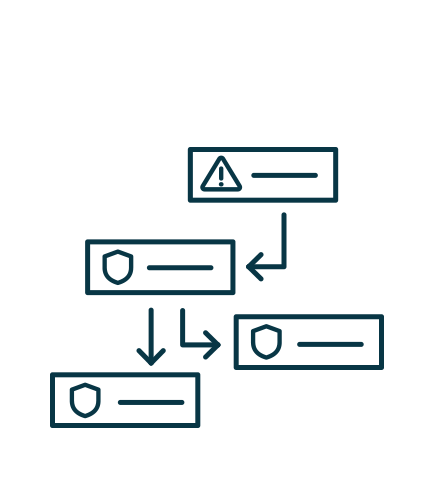
They do not. They harvest credentials and ride the session from the app into the cloud account behind it, then into identity, then into whatever the environment offers next. The app was only just the front door.
The attacker sets the scope, and their scope is “everything reachable”. Yours, if you’re like most security teams, is set by your security vendor list. One tool for the apps, one for the network, one for the cloud, one for the external surface. Each stops precisely where its category ends while the attack doesn’t.
Breaches live in the seams
Look at a typical security stack and you’ll see a map of the attack surface drawn by procurement rather than by adversaries. The tools may be individually excellent but there are borders and seams between them. Nobody owns the handoff from “web app flaw” to “cloud lateral movement”, so nobody tests it. Findings pile up in category-shaped silos while the full path from foothold to impact, the one thing that decides whether you get breached, appears in no report anywhere.
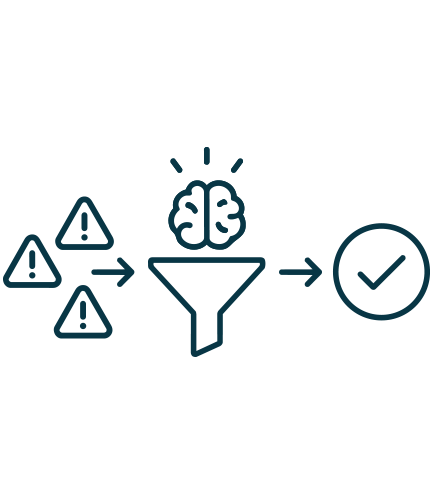
Scanner noise is a symptom caused by tool fragmentation. A tool that sees one slice of your surface can only list every possible flaw in that slice and hand you the triage. It can’t prove exploitability, because proof usually means crossing into terrain it was never built to see.
Attackers can exploit only some of the flaws but your team triages everything, because nothing tells them which flaws actually go anywhere. This gap is where your team’s time is wasted.
The next time a web pentest or scanner report lands in your inbox, pick one finding and ask: “If this was exploited today, what’s the very next thing an attacker could reach – and who in my organization actually knows the answer?”
If nobody can answer past the first hop, you don’t have a scanner problem. You have a validation problem, and it’s not a preview of what’s wrong with your tools. It’s a preview of what’s wrong with any limited-scope test.
Plenty of teams are building AI attackers for a single surface, and some of them are sharp. But the best app-hacking hammer in the room is still a hammer. Point it at your application and it will find nails all day. What it can’t tell you is what happens after the nail gives way, because that part of the story unfolds in your cloud and your identity systems, outside its scope.
A brilliant app attacker that stops at the app has automated one silo. Your map is still vendor-shaped, with one more vendor on it.
What “Native” Actually Means
These days we’re announcing Native AI Web App Pentesting, and the word doing the heavy lifting is “native”. This is the same attack engine that already validates your network, cloud, external attack surface, and AI infrastructure, now targeting your applications. Nothing here was bolted on or duct-taped into a dashboard.
Until now, AI informed the attack. Now it runs it. It discovers the app, maps its structure, reasons through the business logic, and decides its next move in real time, the way a human attacker would. When the attack path continues past the app, we follow it, from the application into the infrastructure, the cloud account, the identity layer, wherever it goes next, on one platform. Attackers don’t stop at the application, and neither do we.
Then deterministic validation confirms what’s actually exploitable and turns it into something a developer can act on: the specific flaw, the specific fix, explained in their language, not ours.
Proven Exploitable, End to End
Every finding comes with a demonstrated exploit and the full attack path mapped to CWEs and MITRE ATT&CK, so your developers get evidence they can fix from instead of a severity score begging for triage. It goes after business logic flaws, the kind that never had a CVE, which is why no scanner database will ever catch them. It tests at the speed of your CI/CD, so validation finally keeps pace with the apps it’s validating. And it runs safely in production, because a test you can only run in staging is a test of your staging.
Attackers Don’t Respect Vendor Boundaries. Neither Should Your Validation.
Your attack surface is one continuous thing. Applications flow into infrastructure, infrastructure into cloud, cloud into identity, identity into everything else. Attackers have always treated it that way, and as of today your validation can too: apps to infrastructure, one platform, every finding proven, CTEM extended into the application layer.
The Pentera AI Web App attacker beta is open to selected customers, and GA lands in Q4 2026. If you’re at Black Hat USA, come watch the AI attacker work live at booth #1652, August 5-6. Bring an app you think is safe.