
Pentera Logo Pentera Logo White
resources
Oct 2026
PHP2Shell: the expiry date on “too hard to exploit”
On 21 October 2026, PHP shipped emergency patches for two critical vulnerabilities, CVE-2026-109618 and CVE-2026-109619,...
Read now
“Pentera helps us prioritize what truly matters and gives us confidence we are covering our global environment continuously.”

“Seeing a domain admin account cracked in production changed how we view internal exposure.”

“Pentera helped us advance our red team and continuously improve penetration testing.”

“Pentera makes it easier to focus on what is truly exploitable instead of chasing long vulnerability lists.”

“In a complex, large-scale environment, Pentera delivers the speed and visibility security teams need.”

“Pentera amplified our team’s performance and delivered measurable value to upper management.”

"Pentera allows us to tailor testing to each service, reduce time and costs, and shift our focus from simply finding vulnerabilities to actively helping our teams fix them.”


Rubén Alonso | Head of Secure
Development Unit, Telefonica

“I don’t think we’d be able to advance our red team without Pentera. If you’re looking to improve penetration testing, I would definitely recommend it.”

Owen Fuller | Cybersecurity Engineering
Manager, Casey’s

Product

Agentic Web App Pentesting

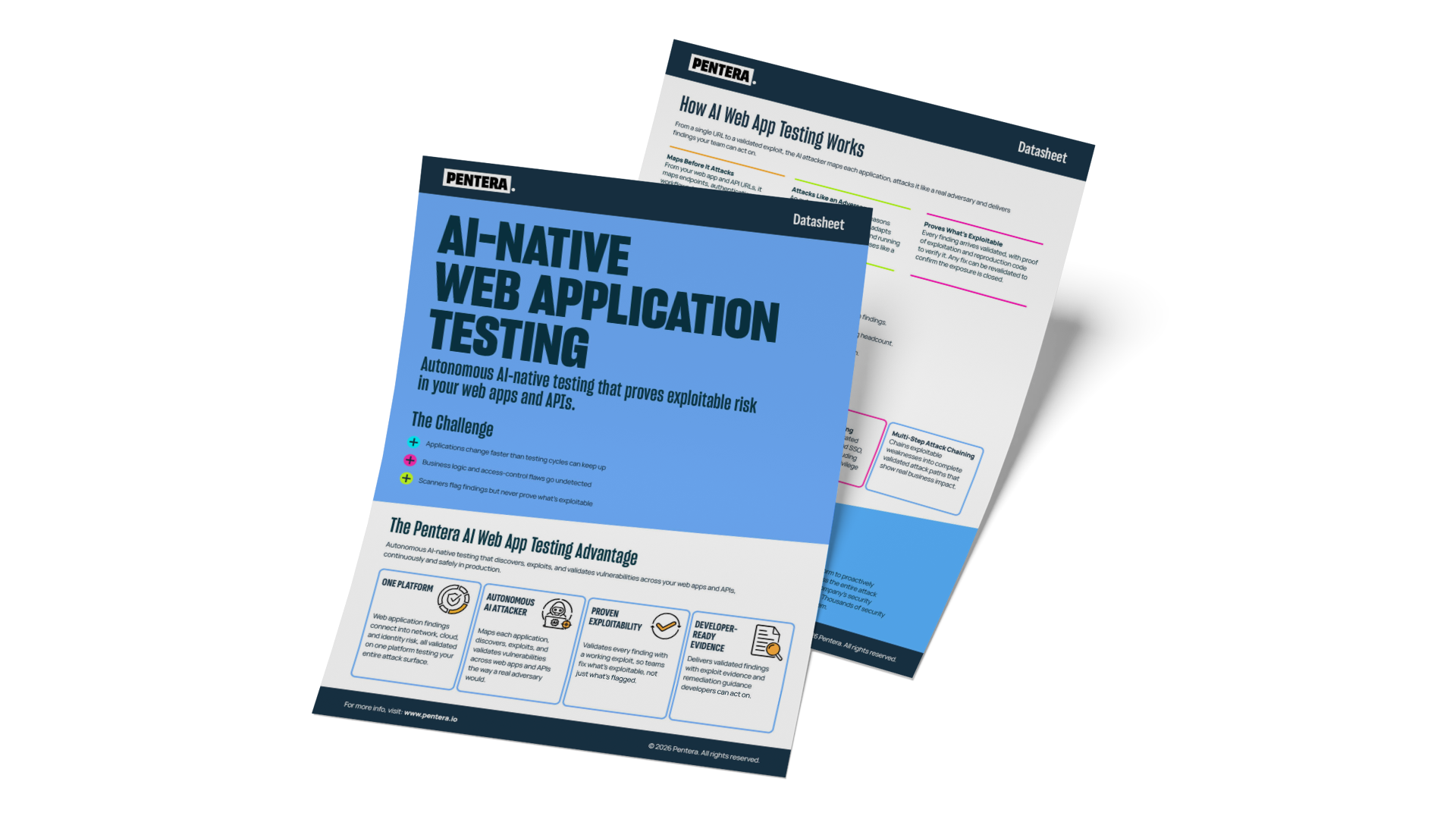
Validate the security of your web applications against real-world attacks with Pentera Apps. Continuously validate your custom, business-critical applications as they change, chain what attackers can exploit into attack paths that show the business risk, and give your team the evidence to prioritize remediation.
Thanks for reaching out! We'll be in touch soon to set up your personalized demo - prepare to unlock security insights about your environment!
TRUSTED CUSTOMERS
APPLICATION TESTING

Identify exploitable security gaps in your web apps

AI-generated, vibe-coded applications reach production faster than periodic pentests can cover them. Pentera Apps identifies exploitable security gaps across web applications and APIs by testing them like a real adversary, informed by context from your environment. The Pentera Apps agentic attack engine acts as an autonomous ethical AI hacker. Guided by Pentera’s Validation Grid™, it maps application behavior, tests workflows behind login across user roles and permissions, reasons through business logic, and adapts payloads in real time. It chains weaknesses into validated attack paths your team can prioritize and fix.

HOW IT WORKS

Pentera Apps starts with context.
The Validation Grid™ directs the attack

Every test draws on context from your environment to plan attacks and validate exploitable weaknesses. Findings are routed to the responsible teams with exploit evidence and remediation guidance. Pentera Apps then revalidates fixes to confirm the attack path is closed.

Contextualize
Combine asset profiles, validated findings, threat actor techniques and cross-stack signals in the Validation Grid™.
Map
Build a map of every route, API endpoint, role, and workflow, unauthenticated and authenticated, including the hidden endpoints attackers look for first.

Plan
Turn every risk into a testable question before a single request is sent, so every test stays targeted and within approved scope.
Validate
Exploit business logic, access-control and session flaws with purpose-trained agents. Confirm exploitability through deterministic checks.
Retest
Run incremental tests on every change and confirm each fix closes the attack path, without the cost of 
a full pentest.
OPERATIONAL OUTCOMES
Cut thousands of scanner findings to the few attackers can exploit, and validate each one's attack path and true business impact.

Scanners flag findings. Pentera Apps validates them.

100%
Validated 
security findings
Move beyond noise to confirmed exploitable findings, backed by evidence your team can act on.
24/7
Continuous 
application testing
Move from scheduled scans to on-demand, inline testing whenever your applications change.
20x
Application 
testing coverage
Increase velocity from a few annually pentested apps to continuous testing across your entire application estate, with no additional headcount.
60%
Reduction in third-party pentesting costs
Replace outsourced, point-in-time web app pentests with autonomous testing your team runs on demand.
VALIDATION GRID™

Attack with the full context of your environment

Pentera’s proprietary Validation Grid™ combines an intelligence data layer and execution harness. It holds asset profiles, validated security findings, threat actor techniques, and cross-stack signals. This context directs production-safe AI agents to the most exploitable attack paths with the greatest business risk.

Asset Profiles
Use asset profiles to give AI agents context about the environment they are testing.

Validated Findings and Cross-Stack Signals
Bring validated security findings and cross-stack signals into the intelligence data layer to guide attack investigation.

Threat Actor Techniques
Use threat actor techniques to guide exposure validation.

Customer-Provided Context
Bring prior pentest reports, supporting files and environment-specific information into the Validation Grid™ to inform attack investigation.

AI IN PENTERA APPS

AI-native testing that validates exploitability

Pentera’s autonomous AI attacker, backed by a decade of offensive security research, tests custom applications in production, staging, or development. Specialist agents, each focused on an attack class, use application context to write and execute exploit code against the target application. A purpose-built execution harness controls what runs, and deterministic checks confirm exploitability before findings are reported.

Safety by design

Run agentic testing in live production on an execution model enterprises have trusted for over a decade,
built so AI reasons freely and acts only within the rules you set. Any test can be stopped at any time.

Deterministic Execution

A purpose-built harness orchestrates every agent and enforces your testing policies. AI determines what to test; the harness controls which actions execute against your applications.

Production-Safe

Test live production applications with non-destructive payloads. Execution controls keep attacks within your defined targets and testing policies.

Repeatable & Auditable

Every finding includes an execution trace, supporting requests and responses, and evidence of exploitability. Findings are independently validated before reporting.

Control Plane

Manage targets, authorization, credentials, budget, and testing policies in one place. The system checks the configuration before testing begins and blocks execution if required settings are missing or invalid.
Pentera’s Exposure Validation Platform

Unified security validation and remediation

Pentera Core
AI internal pentesting
Active Directory (AD) password strength assessment
OWASP top 10 targeted testing
CISA KEV targeted testing
Proactive security controls validation
Ransomware resilience testing/validation
Pentera Surface
External penetration testing
Threat intelligence led pentesting
Phishing emulation
Leaked credential collection and validation
AI-based web attack testing
Code repository testing
Pentera Apps
AI-NATIVE APPLICATION 
& API TESTING
AUTHENTICATED BUSINESS LOGIC & ACCESS-CONTROL TESTING
CONTEXT-AWARE TESTING VIA THE VALIDATION GRID™
INLINE, INCREMENTAL TESTING & REVALIDATION
MULTI-STEP ATTACK CHAINING WITH REPLAYABLE PROOF
Pentera Cloud
Cloud-native infrastructure pentesting
Hybrid cloud and on-prem testing
Kubernetes (K8s) and container adversarial testing
AWS & Azure security controls validation
Pentera Resolve
AI remediation operations (RemOps) orchestration
AI-powered remediation workflows
Risk-based remediation prioritization
Automated SLA tracking
Audit-ready reporting
Auto-triggered revalidation
Features & capabilities

See the risk from an attacker's perspective

Every capability is built to map how your applications work, validate what attackers can exploit, and route findings to the responsible teams with exploit evidence and remediation guidance. Retesting confirms whether fixes close the attack path.
Application and API Mapping

Map every route, single-page app, hidden parameter, and documented or undocumented API before testing begins. Expose the hidden endpoints attackers look for first

Inline, Trigger-Based Testing

Trigger tests on demand, on a schedule, or when endpoints, authentication, or permissions change. Retest only what changed to validate new risks promptly and confirm fixes.

Authenticated Application Testing

Test behind SSO, MFA, and OAuth, mapping each user role separately. Identify the session, token, and privilege gaps that let attackers act as legitimate users.

Business Logic and Access Control

Reason through checkout, order, and account workflows to expose IDOR, BOLA, cross-tenant access, and privilege escalation. Give teams evidence and guidance to fix the authorization flaws scanners miss.

API and Injection Testing

Validate API abuse, SQL and command injection, SSRF, cross-site scripting, and exposed cloud secrets. Give teams evidence and guidance to remediate input-handling flaws that expose data and enable code execution.

Multi-Step Attack Chaining

Chain validated weaknesses into attack paths from web apps and APIs into internal networks, Active Directory, and cloud IAM. Identify the root causes teams need to fix to break the attack paths.

Developer-Ready Evidence

Back every finding with proof of exploit, the request and response, and a replayable script, and see what was ruled out, not just what was found. Route findings to the responsible teams with reproducible exploit evidence and remediation guidance.

Reporting and Revalidation

Generate executive, developer, and compliance reports mapped to PCI DSS, DORA, SOC 2, ISO 27001, HIPAA, and NIS2. Revalidate every fix to confirm the attack path is closed.

What the solution achieves

Web Application security validation
for every role

Your teams already have scanners and pentesters, but each needs evidence it can trust. Pentera Apps gives every role proof from real attacks, so they act on what is exploitable in production, not an abstract findings list.
AppSec and 
Product Security
Turn code analysis and scanner findings into validated risk
Validate authenticated workflows, application logic, and access controls that scanners miss
Give developers a replayable exploit and remediation guidance, then retest fixes
Red Teams and Pentesters
Automate application reconnaissance, attack execution, and exploit validation
Direct the AI attacker in plain language to investigate specific scenarios, including issues found in manual testing
Follow attack paths from the application into internal networks, Active Directory, and cloud IAM
CISOs and Security Executives
View all your attack surface risk in one view: see exploitable application and API risk in the same view as network, cloud, and identity risk
Increase application and API testing coverage without adding manual testing cycles and overhead
Show measurable exposure reduction with validated evidence and revalidation results
Compliance

& GRC
Replace stale, annual pentest evidence with continuously validated proof
Map findings to PCI DSS, DORA, SOC 2, ISO 27001, HIPAA, and NIS2 without a separate reporting cycle
Walk into the next audit with current evidence and optional SECTOR11-signed attestation
DevSecOps & Security Engineering
Test every release inline, without slowing it down
Run app and infrastructure security in one workflow
Catch exploitable issues before they reach production, not after

Frequently asked 
questions

Yes, Pentera Apps runs safely in production. Targets, credentials, and policies are set in the control plane, and scope is checked before any request leaves the system. Unclear or invalid configuration stops the test before any traffic is sent. Every action remains bound to approved scope with a complete audit trail and can be stopped at any moment.

Pentera Apps limits the data shared with AI models to the context required for testing, with sensitive information removed before transmission. Enterprise model-provider agreements guarantee zero retention and no training on customer data. Test credentials are managed through the control plane, held in memory during execution, and discarded when the test ends. Each test runs in isolation. Customer data is processed and stored in your assigned EU or US region, with deletion available on request. Pentera is ISO 27001 and ISO 42001 certified and SOC 2 compliant.

Pentera Apps tests across:

  • Custom, business-critical web applications
  • Authenticated, role-based workflows and business logic behind SSO, MFA, and OAuth
  • REST, GraphQL, and WebSocket APIs
  • Single-page apps, client-side routes, and hidden endpoints
  • Production, staging, and development environments

Pentera Apps attempts exploitation, deterministic validation confirms the result, and dedicated validator agents review it before anything is reported. Conflicting signals stay inconclusive rather than becoming findings. No evidence, no finding.

Yes, Pentera Apps validates business logic and access-control flaws. Pentera Apps reasons through application workflows to identify authorization weaknesses, workflow abuse, broken access control, IDOR, BOLA, cross-tenant access, unauthorized actions, and privilege escalation.

Yes. Pentera Apps revalidates validated findings after remediation to confirm the weakness is no longer exploitable and the exposure is closed.

No. SAST, DAST, and scanners flag potential weaknesses but cannot prove runtime exploitability. Pentera Apps takes findings from SAST, DAST, and scanners as input, executes real attacks against running applications and APIs, and validates which ones are exploitable.

No. Pentera Apps doesn’t need access to source code. Testing starts from a URL, the same way an attacker starts. Credentials and documentation deepen coverage, and imported code analysis findings add context through the Validation Grid™.

No. Manual pentesting and PTaaS run point-in-time, and bug bounties cover only what researchers choose to test. Pentera Apps tests every release continuously and imports your pentest reports to keep validating those findings between engagements.

Yes. Pentera Apps’ reports map findings to PCI DSS, DORA, SOC 2, ISO 27001, HIPAA, and NIS2. For audits that require a signed letter, SECTOR11 consultants can deliver attestation as an optional service.

Pentera Apps combines agentic web app pentesting with Pentera’s all-attack-surface exposure validation platform. The Validation Grid™ combines an intelligence data layer and execution harness to direct production-safe AI agents. Teams can validate exposures, guide remediation, and revalidate fixes across web applications, internal networks, cloud, and identity on one platform.

No. Pentera Resolve assigns each finding to the right team under your SLA and tracks the remediation work, which your teams or integrated workflows carry out. Pentera Resolve then triggers a re-run of the attack path to confirm the fix.